
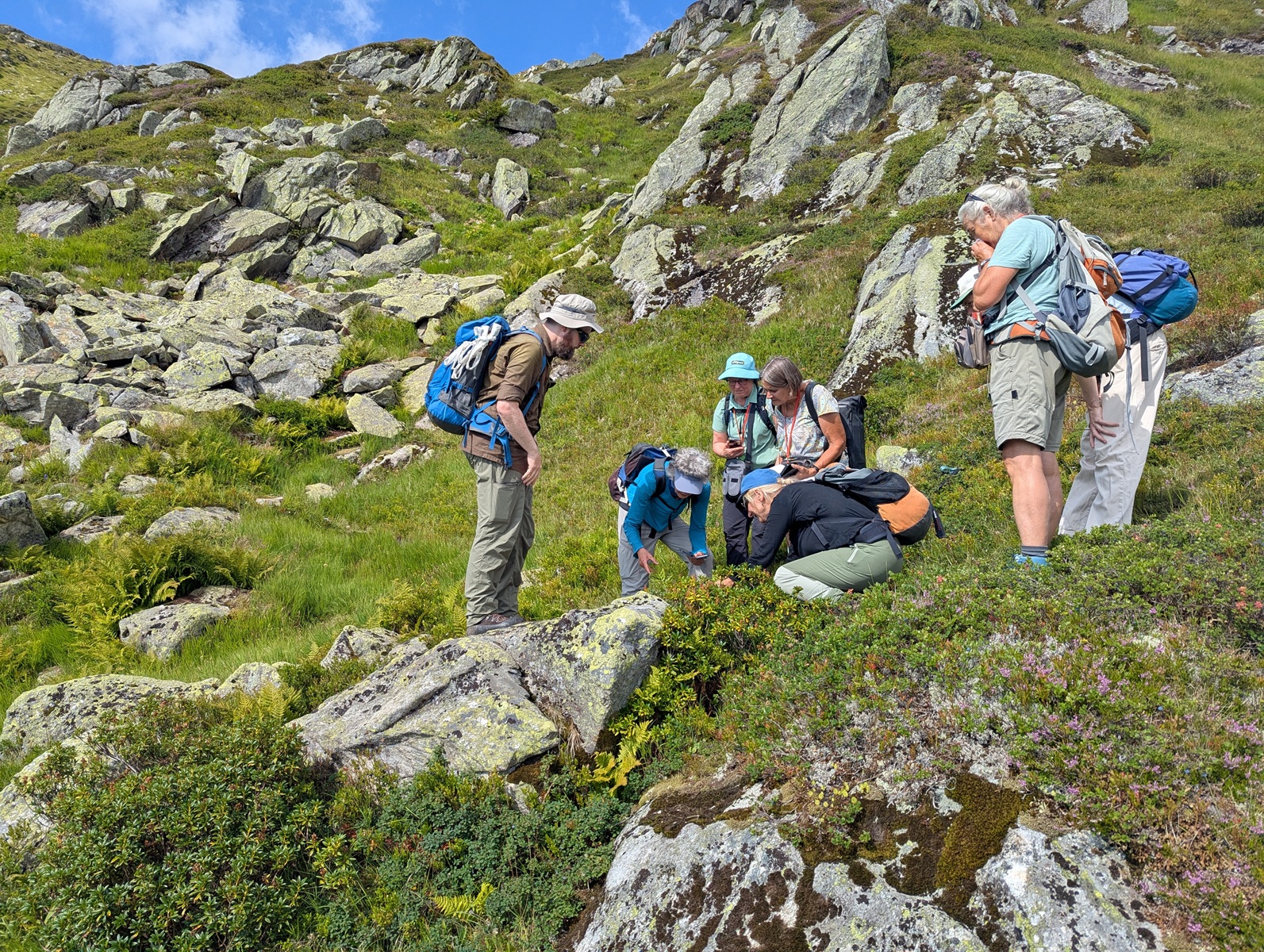
Tschamut is the westernmost village in the canton of Graubünden. In mid-August, 30 mappers were out and about there—on dry meadows, along streams and reservoirs, through floodplain forests, across steep slopes, through remote valleys, and up into high-altitude landscapes, such as Piz Cavradi. Conditions were not always easy: the hot, dry summer had already caused many plants to wither, and large areas had been grazed.
Surprising Biodiversity in a Steep Ravine
The “Ruinas” rapid survey was particularly impressive. The 100 × 100-meter study area is located on a steep slope in a ravine with plenty of tall herbs and green alder thickets—so at first glance, it’s not a place where one would expect to find high plant diversity. But the surveyors were not deterred and found 103 species there.
New species or species not reported for a long time
During a quick survey in Maighels, participants discovered the fragile bladder fern (Cystopteris fragilis), a new species for the survey square. The Alpine willowherb (Epilobium anagallidifolium) also reappeared—the last record of this species here dated back to 1982.
There were also some surprises in Val Sumvitg: the German tamarisk (Myricaria germanica) is a new species for the valley. In addition, the presence of the single-sheathed bulrush (Eleocharis uniglumis) was confirmed.
Plant hunting requires stamina
In addition to the plants we found, the shared experiences also remain in our memories. Take, for example, the legendary “Oberalp-Tschamut Rail Expedition”: While Dorith reminded us every half hour that “we really ought to eat something,” the magnifying glass remained more important than lunch. The picnic on the little bench finally took place around half past three—and only then did the pace toward Tschamut pick up “a bit.”
That evening, the group wrapped up the day with a good meal, identified plants together, and discussed and talked shop long into the night.
Last mapping weekend of the season
The Tschamut mapping weekend was also the last mapping weekend of the 2026 season. And it left a significant mark on the Surselva: In the 5×5‑km square around Oberalpstock, only 23 species had been recorded in Graubünden up to that point. Now there are 249. And that’s after just one day of mapping in this remote square—an impressive result.
Thank you very much for your tremendous dedication to Flora Raetica!