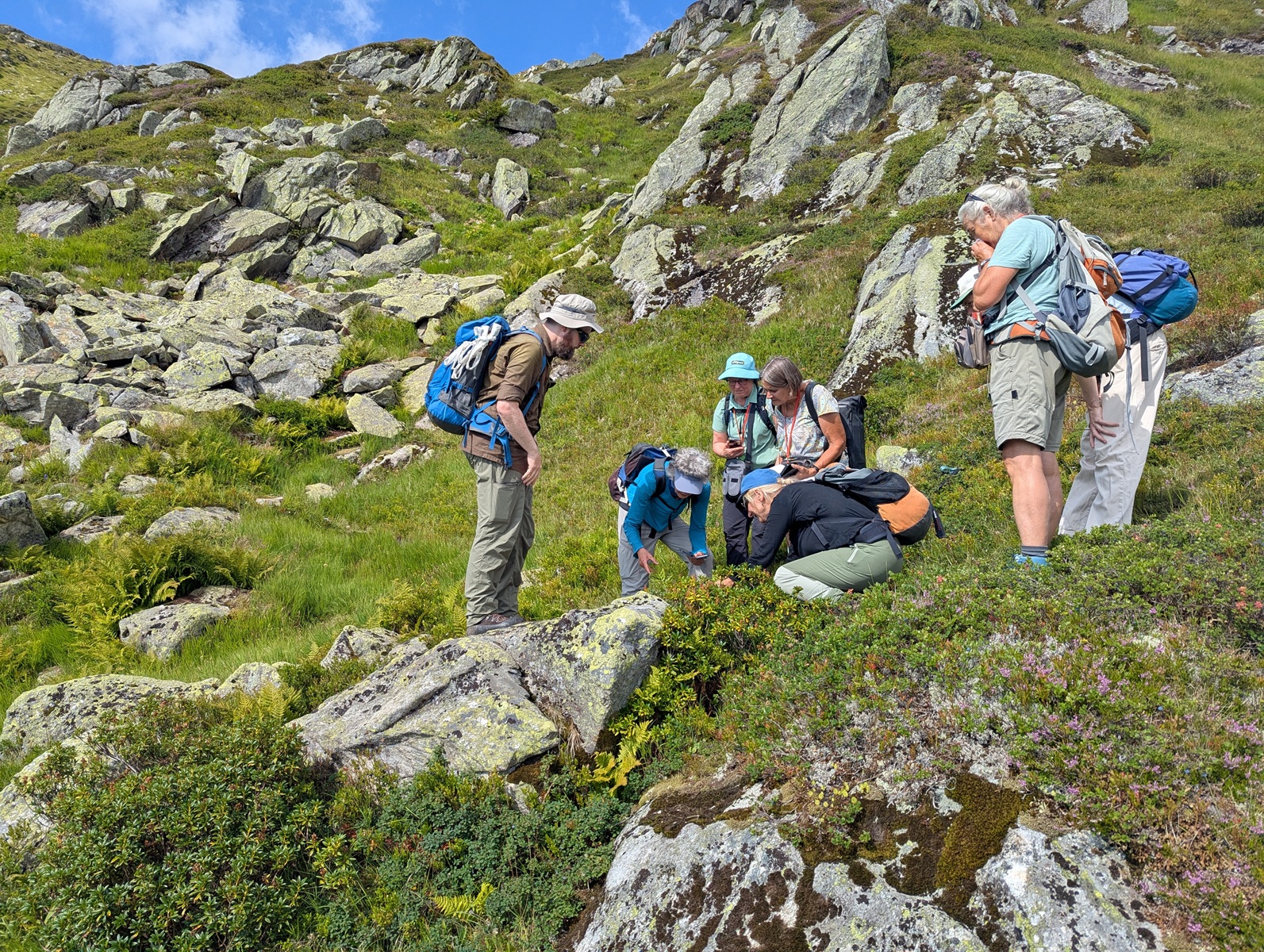

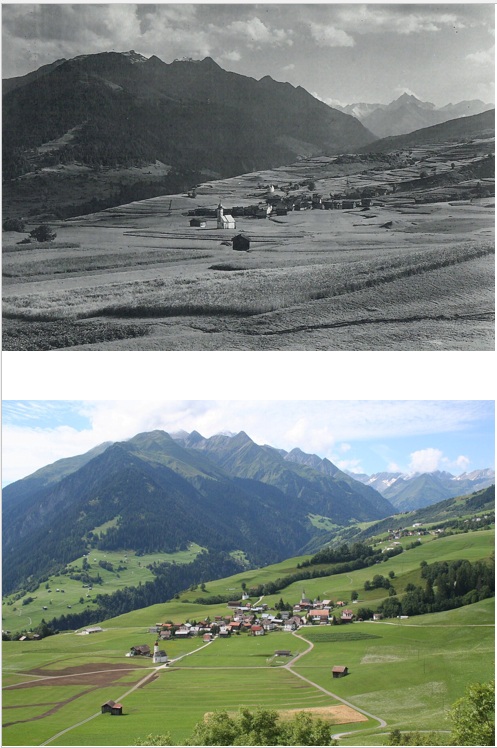
Can we see the effects of social change or global warming since 1900 in the flora of Graubünden? Flora Raetica is investigating this question through comprehensive mapping and comparing historical records of plant sightings with current occurrences. Thomas Wohlgemuth, co-president of Flora Raetica, provided answers to these questions on September 16 during the “Rendez-vous am Mittag” event hosted by the Graubünden Natural History Museum. About 60 interested attendees listened to his presentation.
Fewer farm fields, more urban areas and forests
Using historical photos, Wohlgemuth vividly illustrated how our ancestors practiced agriculture on a small scale and with a great deal of manual labor throughout Graubünden.
Over the past hundred years, the fields surrounding the villages have largely disappeared—and with them, traditional crops such as flax, hemp, and rye.
In many valley areas, wet meadows and natural river landscapes have disappeared, and meadows that were once nutrient-poor are now fertilized even at high elevations. There has been an increase in built-up areas, roads, farm access roads, and also forested areas.
Over fifty new species in forests
Changes in habitats are also reflected in the plant community. In the current mapping efforts, new species are emerging—particularly along transportation routes, rivers, and other ruderal sites—including many neophytes. Some are spreading rapidly and are therefore being specifically controlled, such as the glandular impatiens and Japanese knotweed.
Among the species found in rich fens—which are much more common today than in the past—only a handful of new species have been added, such as the thread-leaved speedwell. More than 50 new species now grow in the forests, including several tree species such as Douglas fir and red oak, which were intentionally planted, as well as shade-tolerant neophytes such as the autumn cherry.
At the same time, many species of former agricultural crops have disappeared or become less common, including, for example, corn cockle and several species that grow in flax fields: flax cockle, flax silk, and flax ragwort.
Surprisingly, several dozen of the numerous neophytes already known around 1900 have disappeared. They were apparently unable to become established.
Blueberries are particularly widespread
The mapping also reveals significant differences in the distribution of the approximately 3,000 plant species. According to Wohlgemuth, about 400 species have so far been recorded in only a single 5 × 5‑km square and are therefore among the species that are particularly rarely recorded, such as the moor gentian at Heidsee or the dyer’s woodruff at Ellhorn.
At the other end of the spectrum are the blueberry and the crested water-crowfoot: both have been found in 84 percent of the surveyed areas so far and are the most widespread species.
Mapping will continue through 2028
The more thoroughly today’s plant populations are documented, the more accurately we can track how the flora of Graubünden is changing. Flora Raetica will therefore continue its mapping efforts through 2028. New volunteers are always welcome!